

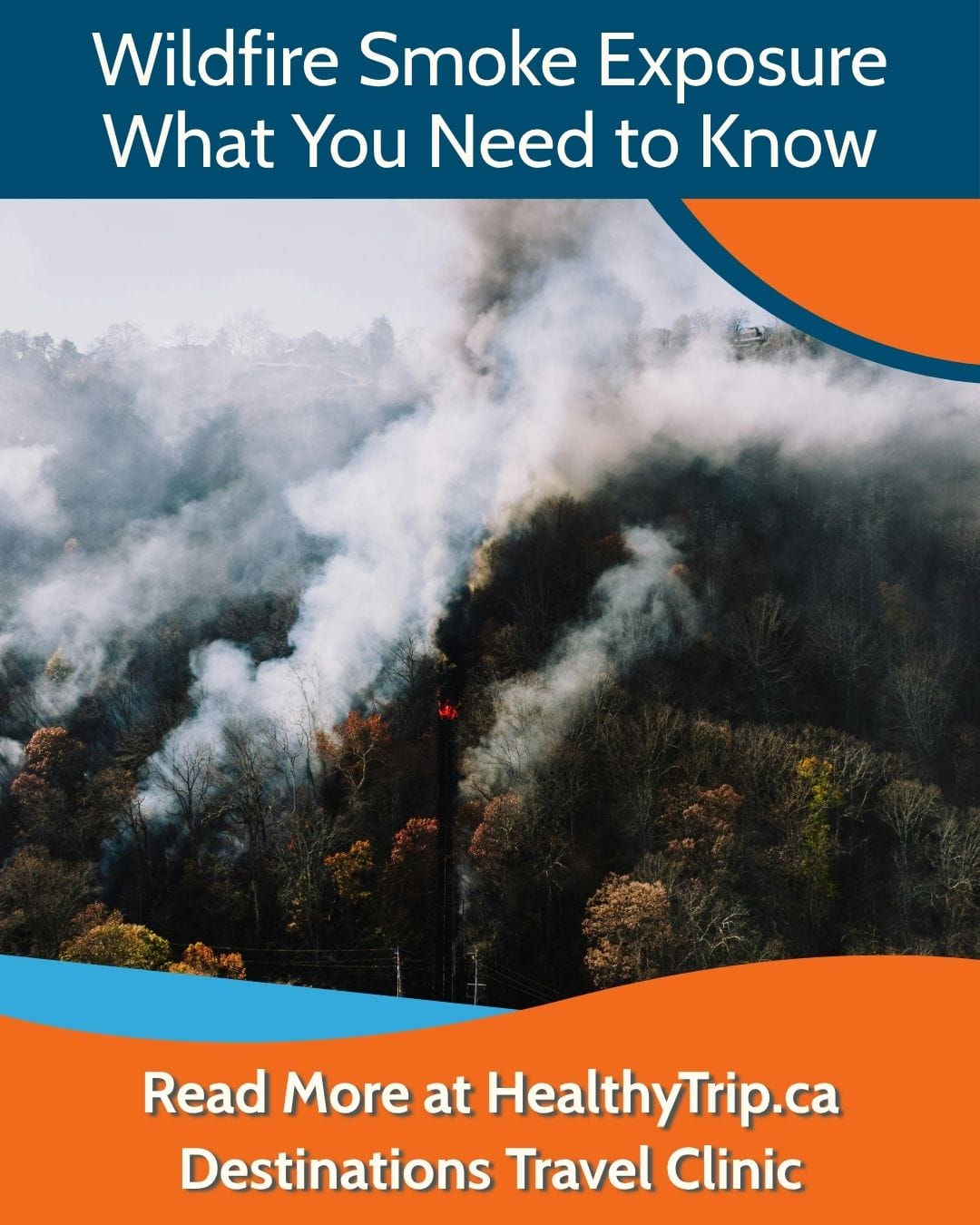
If you’re traveling within Canada this summer — whether for business, leisure, or family — there’s one growing public health threat that could affect your entire body: wildfire smoke.
Hazy skies and poor air quality are now common across provinces like British Columbia, Alberta, Saskatchewan, and even Ontario and Quebec. But wildfire smoke isn’t just about your lungs. As emerging research warns, it may be affecting your brain, heart, fertility, and even your long-term cancer risk.
At Destinations Travel and Immunization Clinic, we want travelers and healthcare professionals to know that wildfire smoke contains extremely fine particles (PM2.5) — tiny enough to:
- Penetrate deep into your lungs
- Enter your bloodstream
- Cross the blood-brain barrier
This means the health impacts can go far beyond coughing or asthma.
Cognitive Impairment: Brain Fog, Dementia, and More
Wildfire smoke exposure has been linked to decreased cognitive performance, mental fatigue, and even an increased risk of dementia. One large U.S. study involving over 1.2 million people found that the risk of dementia was significantly higher for those exposed to wildfire smoke compared to regular air pollution. Even short-term spikes lasting a few hours were associated with lower attention and concentration scores.
Beyond the Lungs: Cardiovascular and Whole-Body Risk
While links to heart disease and stroke are similar to those seen with other pollutants, wildfire smoke may elicit 3–4 times more severe acute respiratory reactions than traffic or industrial pollution, according to environmental health scientists. The particles don’t just affect your lungs — they access every organ in your body.
Impact on Infants and the Next Generation
As McGill epidemiologist Dr. Scott Weichenthal points out, children born in the last five years are developing in an environment where summer wildfire smoke is routine. This exposure during critical stages of growth may have long-term, poorly understood implications — potentially affecting neurodevelopment, immune function, and metabolism.
Cancer Risk from Repeated Exposure
Weichenthal’s 2023 population study — which followed over 2 million Canadians for nearly two decades — found that people exposed to wildfire smoke were more likely to develop lung cancer and brain tumours. This should not be surprising, he says, since wildfires emit multiple known human carcinogens.
What Can You Do Before You Travel?
If you’re heading to areas prone to wildfires (Western Canada, Northern Ontario, etc.), here are a few important steps:
- Check Air Quality Health Index (AQHI) daily at your destination.
- Carry N95 masks and consider indoor activities on high-smoke days.
- If you have respiratory, cardiac, or neurological conditions, talk to a healthcare provider about preventive medications or travel safety plans.
- Consult your pharmacist or travel health provider about how wildfire smoke might interact with your existing medications or conditions.
At DTC, we don’t just help you plan for Zika or typhoid — we help you stay safe when travelling within Canada too. We offer personalized, evidence-informed guidance to help you prepare for air quality risks before you depart.
We’re here to help you breathe easier, wherever your summer takes you. Protect yourself Before you Travel!
Stay Connected with Destinations Travel and Immunization Clinic! healthytrip.ca/travel-blog
Because Your Health Doesn’t Take a Vacation — Even When You Do.
If you found this article helpful, don’t forget to like, share, and Follow to stay up to date on our latest travel health tips, updates, and wellness advice.
The medical information on this site is provided as an information resource only and is not to be used or relied on for any diagnostic or treatment purposes. This information does not substitute for professional diagnosis and treatment. Please do not initiate, modify, or discontinue any treatment, medication, or supplement solely based on this information. Always seek the advice of your health care provider first. Full Disclaimer