

At Destinations Travel and Immunization Clinic, we specialize in protecting you before, during, and after your travel—and that increasingly includes protecting you from risks right here at home. One such risk is Lyme disease, a growing public health concern across Canada due to the expanding presence of blacklegged ticks.
What Is Lyme Disease?
Lyme disease is a potentially serious illness caused by the bacterium Borrelia burgdorferi, transmitted through the bite of infected blacklegged ticks. If left untreated, it can lead to severe joint pain, heart issues, and nervous system complications. In many cases, people don’t even realize they’ve been bitten.
Since 2009, over 27,000 cases of Lyme disease have been officially recorded in Canada, and the actual number is likely much higher due to underreporting and misdiagnosis. Nova Scotia, Ontario, and several other provinces are experiencing record-high tick populations, especially during the warmer months.
A Lyme Disease Vaccine Is Coming — Here Is Where Things Stand
For decades, the only tools available to prevent Lyme disease have been tick checks, repellents, and protective clothing. That is about to change.
Pfizer and Valneva SE have been developing a Lyme disease vaccine called VLA15 (PF-07307405) for several years. In March 2026, they announced the results of the Phase 3 VALOR trial — the largest and most rigorous clinical study of a Lyme vaccine ever conducted. The results were encouraging:
The vaccine demonstrated 73-74% efficacy in preventing confirmed Lyme disease cases across all study participants, including children as young as five years old. The trial was conducted across the United States, Canada, and Europe, and included high-risk groups such as outdoor workers, hikers, and dog owners.
Following those results, Pfizer announced plans to submit a Biologics License Application (BLA) to the U.S. Food and Drug Administration (FDA) and a Marketing Authorization Application (MAA) to the European Medicines Agency (EMA) in 2026. Health Canada has not confirmed a separate timeline, but typically reviews applications closely following FDA decisions. If FDA approval is granted in late 2026 or early 2027, Canadian authorization could follow within months.
No Lyme disease vaccine is approved or available in Canada today. When that changes, Destinations Travel Clinic will be among the first to offer it. We will post updates on our blog and social channels as the regulatory timeline becomes clearer. Follow us on Facebook and Instagram to stay informed.
Update (August 2026)
The European Medicines Agency has formally accepted Pfizer and Valneva’s submission for VLA15, moving the vaccine one step closer to approval in Europe. A parallel U.S. FDA submission is expected on the same timeline. Health Canada has not confirmed a separate review date, but approval typically follows closely behind European and American decisions.
Why Now? And What Took So Long?
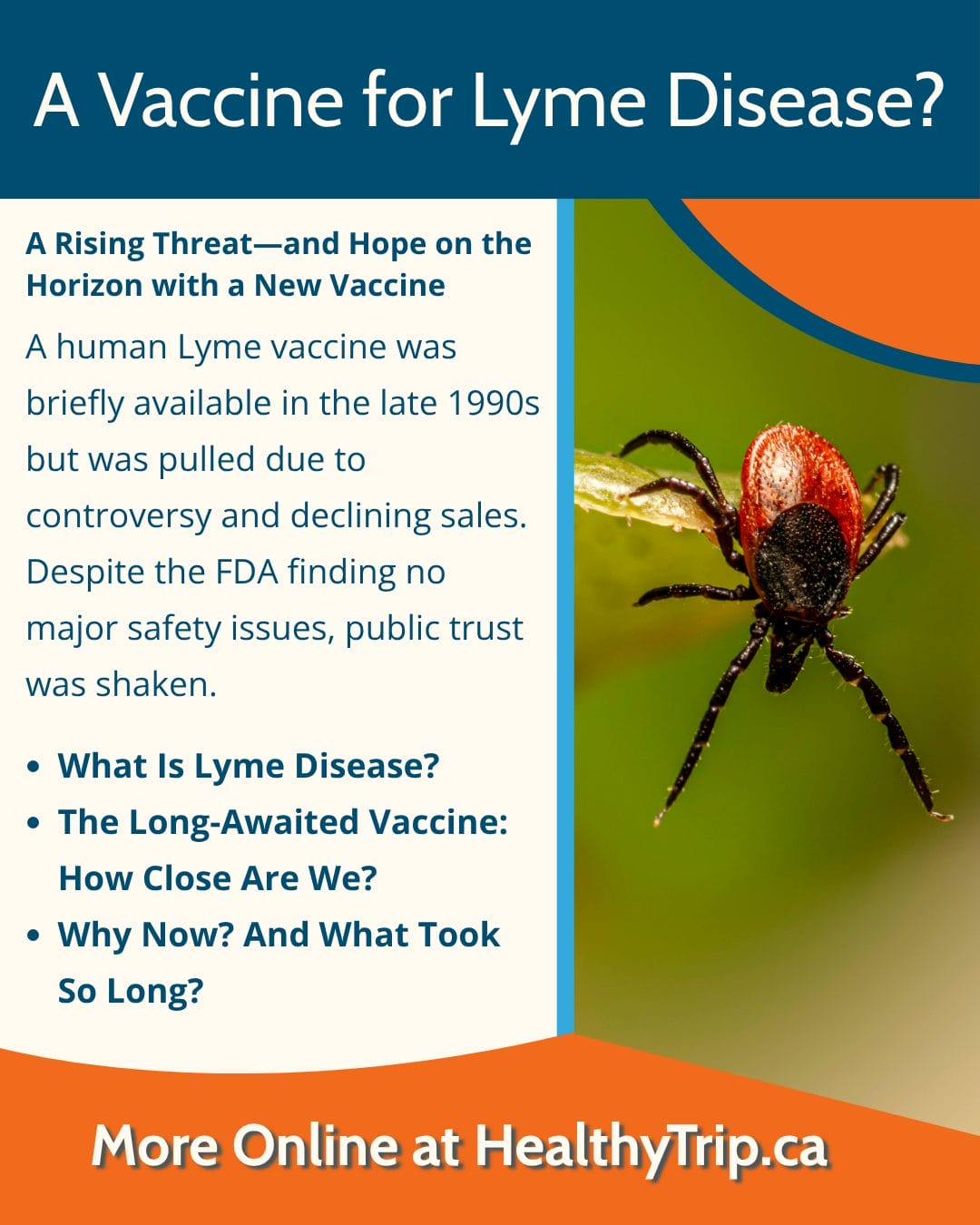
Surprisingly, a human Lyme vaccine was briefly available in the late 1990s but was pulled due to controversy and declining sales. Despite the FDA finding no major safety issues, public trust was shaken.
Today, the growing threat of Lyme—amplified by climate change and ecological shifts—has reignited research and public demand. Other vaccine innovations are also underway, such as edible vaccines for mice (to reduce infected tick populations) and immunization technologies that target tick saliva itself.
What You Can Do Now
What to do if You Find a Tick
In Ontario, tick bites can be treated quickly through Ontario’s minor ailment program. Our partner and nearby pharmacy, Centrum Pharmacy, can help if you are bitten by a tick.
How to Prevent Tick Bites
While we wait for a human vaccine, it’s important to protect yourself—especially during tick season:
- Wear long sleeves and pants in wooded or grassy areas
- Use DEET-based insect repellents
- Perform thorough tick checks after outdoor activity
- Wash and dry clothing at high temperatures
- Protect your pets with veterinary-approved tick preventatives
At Destinations Travel and Immunization Clinic, we provide pre-travel consultations, vaccinations, and up-to-date advice on how to stay safe from Lyme disease, both abroad and here in Canada. If and when the vaccine becomes available, we’ll be among the first to offer it—ensuring our patients get timely, science-based protection.
Final Thoughts
Ticks are small, but the consequences of Lyme disease can be life-changing. A safe, effective vaccine could finally allow Canadians to enjoy nature without fear. Until then, awareness, prevention, and expert guidance from clinics like ours remain your best defense.
Stay Connected with Destinations Travel and Immunization Clinic! healthytrip.ca/travel-blog
Because Your Health Doesn’t Take a Vacation — Even When You Do.
If you found this article helpful, don’t forget to like, share, and Follow to stay up to date on our latest travel health tips, updates, and wellness advice.
Frequently Asked Questions
Not yet. No Lyme disease vaccine is currently approved or available in Canada. Pfizer and Valneva completed Phase 3 clinical trials in March 2026 with strong efficacy results (73-74%) and have announced plans to submit for FDA and EMA approval in 2026. Health Canada approval would follow. We expect availability in Canada in 2027 at the earliest, depending on the regulatory timeline. Follow Destinations Travel Clinic on Facebook and Instagram for updates as the approval process progresses.
Based on Pfizer’s announced regulatory submission timeline for 2026, and assuming FDA approval follows in late 2026 or 2027, a Health Canada authorization could realistically come in 2027. Destinations Travel Clinic will offer the vaccine as soon as it is approved and available. Check back at this page or contact us directly for the latest update.
The Phase 3 VALOR trial, results announced in March 2026, showed efficacy of 73-74% in preventing confirmed Lyme disease cases. The trial included adults and children aged five and older across North America and Europe, and covered high-risk populations including outdoor workers and frequent hikers.
Yes. A vaccine called LYMErix was approved by the FDA in 1998 and was briefly available in the United States. It was voluntarily withdrawn from the market in 2002, not due to safety concerns identified by regulators, but because of declining sales and public controversy during a period of broader vaccine hesitancy. It was never approved in Canada. The new Pfizer/Valneva vaccine is a different product developed with updated science.
Since no vaccine is currently available, prevention relies on avoiding tick bites and catching them early if they occur. Wear long sleeves and pants in wooded or grassy areas, use Health Canada-approved insect repellent containing DEET or icaridin, do thorough tick checks after outdoor activity, and wash and dry clothing at high heat. Protect pets with veterinary-approved tick preventatives.
Remove it promptly using fine-tipped tweezers, grasp the tick as close to the skin as possible and pull upward with steady, even pressure. Do not twist or jerk. Do not use petroleum jelly, nail polish, or heat. In Ontario, tick bites are covered under the Minor Ailment Program, meaning you can be assessed and treated at a pharmacy without a doctor’s appointment. Our partner Centrum Pharmacy, located at the same address as Destinations Travel Clinic, can help.
Blacklegged tick populations have been identified and are growing across much of southern and eastern Ontario, including the Ottawa region. Known risk areas include the Thousand Islands, Long Point, Prince Edward County, Rondeau Provincial Park, and areas along the north shore of Lake Erie and Lake Ontario. The Ottawa-Gatineau region has seen increasing tick activity in recent years.
Yes. Travel clinics like Destinations Travel Clinic provide advice on insect-borne disease prevention, including Lyme disease, for both domestic and international travel. When the Lyme vaccine becomes available, travel clinics are expected to be among the primary providers. In the meantime, we can advise on current prevention strategies and, if you are travelling to high-risk regions internationally, assess any additional tick-borne disease risks relevant to your destination.
The medical information on this site is provided as an information resource only and is not to be used or relied on for any diagnostic or treatment purposes. This information does not substitute for professional diagnosis and treatment. Please do not initiate, modify, or discontinue any treatment, medication, or supplement solely based on this information. Always seek the advice of your health care provider first. Full Disclaimer