

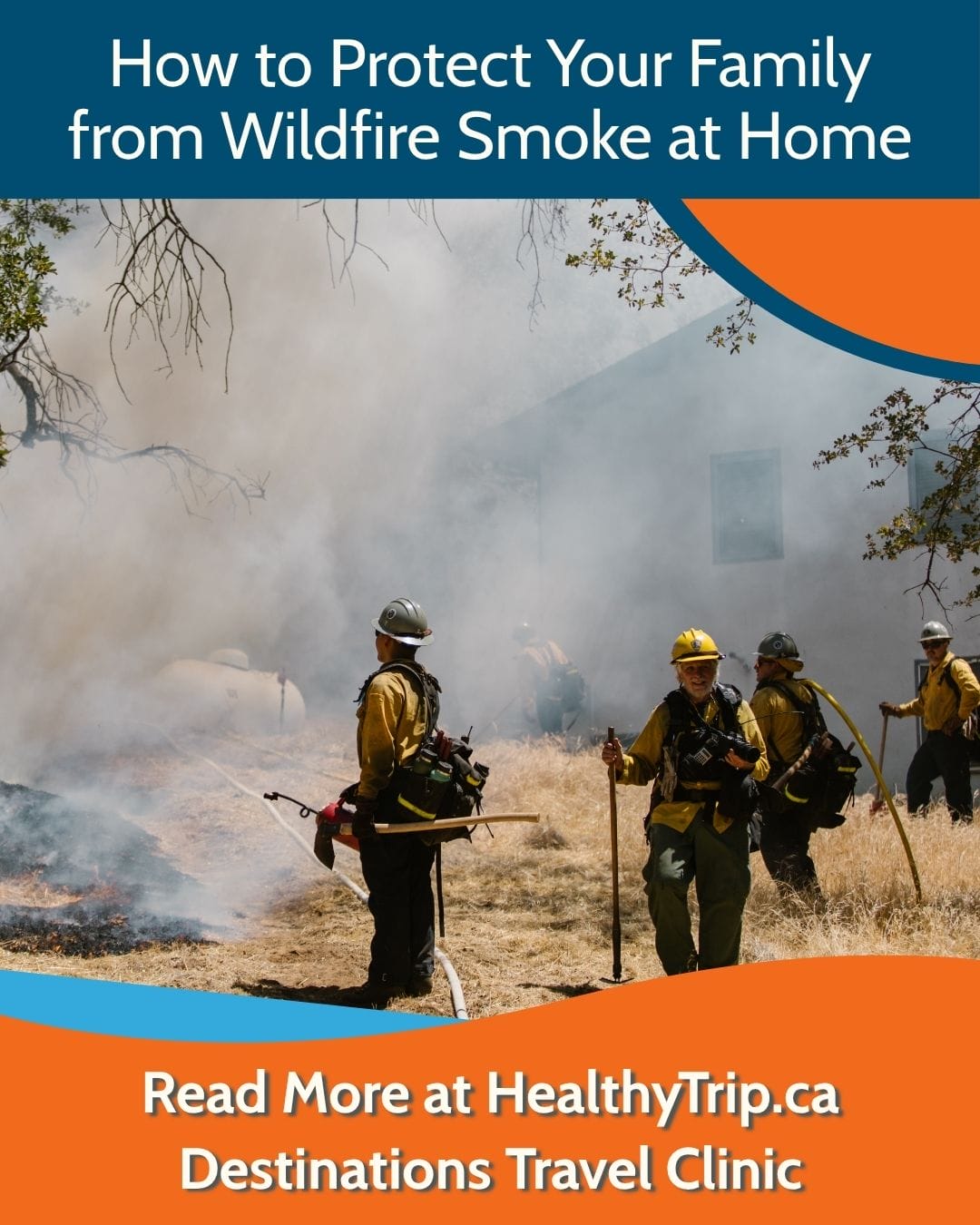
When wildfire smoke blankets parts of Ontario, the hazy skies and smell of burning wood are clear reminders of the changing environment. But even when the smoke drifts hundreds of kilometres away from the active flames and becomes less visible, it remains a serious health concern.
According to the Canadian Lung Association, there is no safe level of wildfire smoke. The fine particulate matter hidden within that haze can penetrate deep into our lungs and enter our bloodstream, triggering inflammation and respiratory distress. For vulnerable populations, including infants, young children, pregnant individuals, seniors, and those with chronic heart or lung conditions, these effects can manifest at much lower pollution levels than in healthy adults.
To help you safeguard your household, here is a practical, evidence-based guide to managing indoor air quality and protecting your lungs during wildfire events. If you’re travelling during a smoke event rather than sheltering at home, see our travel-specific wildfire smoke guidance as well.
The Big Question: Does Air Conditioning Help?
Yes, but only if used correctly.
A common misconception is that home air conditioners pull in fresh air from the outside. In reality, the vast majority of central AC systems and window units solely recirculate and cool the air already inside your home.
- Standard AC units are perfectly safe to run. They help lower indoor temperatures so you can comfortably keep windows and doors tightly sealed against the outdoor smoke.
- Systems with fresh air intakes. If your HVAC setup or window unit features an outdoor air control, you must proactively change its settings. Switch the system to “recirculate mode” or manually shut the outdoor intake damper to prevent smoky air from being drawn into your living spaces.
Important note on heat vs. smoke: if you do not have air conditioning and indoor temperatures exceed 26 degrees C with windows closed, extreme heat becomes the immediate threat. Prioritize staying cool by relocating to a designated community cooling centre, local library, or shopping mall where the air is both filtered and cooled.
Navigating the Air Quality Health Index (AQHI)
The Government of Canada monitors real-time air pollution through the Air Quality Health Index (AQHI). Checking this index daily allows you to tailor your family’s outdoor exposure based on current risk levels:
| AQHI Rating | Risk Level | At-Risk Groups | General Population |
|---|---|---|---|
| 1–3 | Low | Enjoy outdoor activities normally. | Ideal weather for outdoor activities. |
| 4–6 | Moderate | Consider reducing or rescheduling strenuous outdoor activities if experiencing symptoms. | No need to modify activities unless you experience throat irritation or coughing. |
| 7–10 | High | Reduce or reschedule strenuous outdoor activities. Children and seniors should take it easy. | Reduce or reschedule strenuous outdoor activities if you experience symptoms like coughing. |
| Over 10 | Very High | Avoid strenuous outdoor activities. Children and seniors should remain indoors. | Avoid or reschedule strenuous outdoor activities. |
Creating a Cleaner Air Space at Home
To significantly lower the fine particle burden inside your home, focus on continuous air filtration.
- Upgrade your furnace filter. Install a filter with a MERV (Minimum Efficiency Reporting Value) rating of at least 13, or the highest efficiency your system can safely handle. Run the system’s fan continuously (switch it from “Auto” to “On”) to keep air moving through the filter.
- Utilize HEPA air purifiers. Place a portable air purifier equipped with a true HEPA filter in the rooms where your family spends the most time, such as bedrooms or the living room.
- DIY alternative (Corsi-Rosenthal box). If commercial purifiers are inaccessible, you can construct a highly effective air cleaner using a standard box fan, four MERV 13 furnace filters, cardboard, and duct tape.
- Minimize indoor pollutants. Avoid activities that add particles to your indoor air: smoking or vaping indoors, burning candles or incense, frying or broiling foods, and vacuuming (which kicks up settled dust).
Masking Up: When and How
If you must spend extended periods outside during a high-risk smoke event, standard surgical or cloth masks are insufficient. They lack a tight seal and allow fine smoke particles to pass right around the edges.
Instead, opt for a well-fitted respirator mask, such as an N95, KN95, or KF94. These are designed to fit snugly against the face, covering your nose, mouth, and chin completely, and are constructed from material capable of filtering out microscopic fine particles.
- Gases vs. particles. Be aware that while respirators filter out harmful particulate matter, they do not protect against the toxic gases contained in wildfire smoke.
- Contraindications. Respirator masks should never be placed on children under the age of two, or on anyone who experiences increased difficulty breathing while wearing them.
- Heat stress. If poor air quality overlaps with extreme heat, wearing a respirator can increase heat strain. In these scenarios, the Public Health Agency of Canada emphasizes that staying cool remains the absolute priority.
Proactive Medical Management
If you or your children live with asthma or Chronic Obstructive Pulmonary Disease (COPD), wildfire season requires strict adherence to your medical management plan.
- Maintain an adequate supply of both your routine “controller” medications and your fast-acting “reliever” inhalers.
- Understand your inhalers. Daily controller medications (typically containing inhaled corticosteroids) must be taken exactly as prescribed to keep baseline airway inflammation low. Reliever medications (such as salbutamol/Ventolin) are bronchodilators meant to quickly relax airway muscles during acute symptom flare-ups. Keep your reliever inhaler with you at all times.
When to Seek Immediate Medical Attention
Wildfire smoke can provoke severe cardiovascular and respiratory emergencies. Monitor your family closely and seek urgent medical evaluation or visit the nearest emergency department if anyone experiences dizziness or lightheadedness, chest pain or tightness, a severe unrelenting cough, shortness of breath or severe wheezing, or heart palpitations (an irregular or racing heartbeat).
By understanding how your home ventilation works, monitoring the AQHI, and ensuring your respiratory medications are close at hand, you can confidently navigate seasonal smoke warnings and keep your household safe.
If you’re planning travel during wildfire season, our travel health team at Destinations Travel & Immunization Clinic can help you prepare for smoke and heat exposure at your destination as well.
Stay Connected with Destinations Travel and Immunization Clinic! healthytrip.ca/travel-blog
Because Your Health Doesn’t Take a Vacation — Even When You Do.
If you found this article helpful, don’t forget to like, share, and Follow to stay up to date on our latest travel health tips, updates, and wellness advice.
The medical information on this site is provided as an information resource only and is not to be used or relied on for any diagnostic or treatment purposes. This information does not substitute for professional diagnosis and treatment. Please do not initiate, modify, or discontinue any treatment, medication, or supplement solely based on this information. Always seek the advice of your health care provider first. Full Disclaimer